
Africa Is Not Failing. We Were Set Up to Fail.
I wrote a blog about how Asia is winning at trade and business and what lessons Africa can learn from the experience. The response was overwhelming. Comments flooded in from everywhere—LinkedIn, WhatsApp, TikTok—and it became clear that this conversation touched something deep.
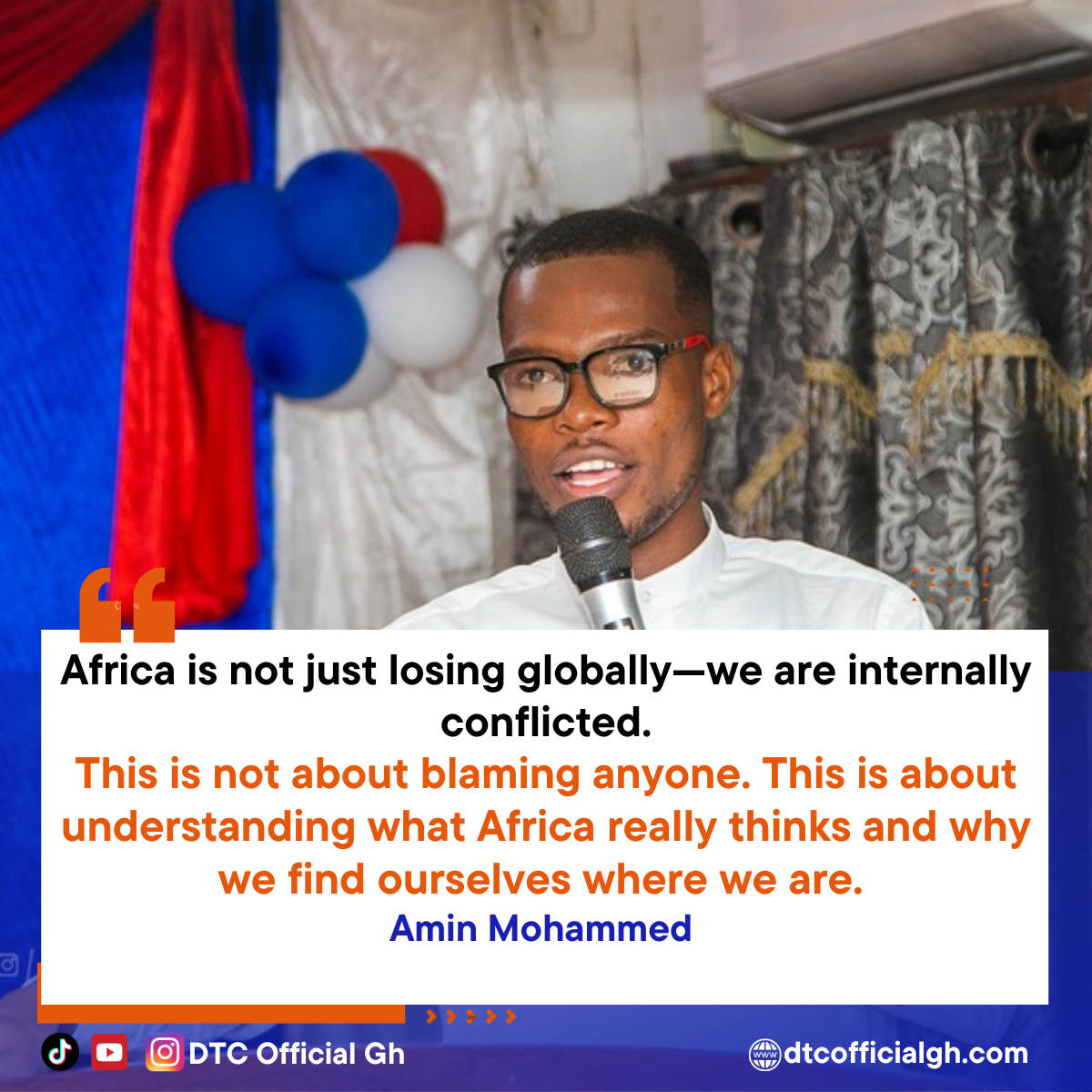
So I sat down to react to your comments. And what I discovered was not just about economics. It was about something far more fundamental: Africa is not just losing globally—we are internally conflicted.
This is not about blaming anyone. This is about understanding what Africa really thinks and why we find ourselves where we are.

The Structural Disadvantage: Competing with One Arm Tied
One commenter, Caleb Apedoh, captured the heart of the problem:
“When foreign companies can borrow at 1% in Europe or Asia and then compete in Ghana where local entrepreneurs face 20 to 30% lending rates, we are not talking about competition. We are talking about structural disadvantages that pushes our brightest graduates to look for hope abroad instead of building at home.”
And he is right.
This is not about hard work or innovation. This is about how global systems are designed. Foreign companies are backed by cheaper capital, stronger currencies, and stable systems. Meanwhile, African businesses fight inflation, high interest rates, and policy uncertainty.
It is not a level playing field. We are competing in a system designed for African businesses to never win.
A 2025 Moody’s report confirms this grim reality: borrowing costs for governments and businesses in South Africa, Nigeria, and Kenya have risen significantly over the past five years. While South Africa benefits from deeper domestic capital markets, its borrowing costs are still high compared to emerging market peers. Kenya faces shallow markets and policy uncertainty. Nigeria struggles with high inflation and limited savings.
READ ALSO: Building Cape Coast as a Business City Starts on the Ground, Not in the Air
Yet another commenter, Antwi Adjei, added an uncomfortable layer:
“Our banks get such funds from Europe at cheap rates and gives to businesses at high rates. Sometimes they give the loans to businesses when the time they needed has elapsed which makes the businessmen default, and they chase them up like criminals.”
This is the cruel irony: African banks borrow cheaply from international markets and lend at predatory rates to local entrepreneurs. The Pan-African Manufacturers Association has noted that elevated borrowing costs across the continent are “constraining access to credit and curtailing the capital investment that growth in manufacturing output would ordinarily require”.
I have never advised any young or upcoming entrepreneur to go into business with a loan. The conditions are set to help you fail.
The Trust Deficit: Can African Businesses Be Trusted?
Patrick Chidi asked a tough question:
“Can local companies in Africa be trusted with such confidence that they will not mess up with the loan once it is granted to them?”
It is a valid question. Yes, there are cases of mismanagement, governance issues, and corruption.
But let me ask you this: If African businesses cannot be trusted, why do foreign companies succeed in the exact same environment?
The problem is not just trust. The problem is the lack of systems, structures, monitoring, and support. In Ghana today, registering a business alone is a nightmare. You need to “sort” people who are already being paid to do their jobs. You pay additional money for people to do what they were hired to do.
You cannot fix distrust by denying people capital. You fix it by building systems and structures that make success more possible than failure.
Nsikan Utuk Ubi, CEO of Nubi Consulting, put it perfectly: “Growth without structure is simply chaos at scale. Sustainable businesses are built deliberately, not accidentally”.
READ ALSO: It’s Not Money, It’s the Plan – Every Entrepreneur Must Learn
Mindset: The Uncomfortable Conversation
Nelson Godfred Agyeman raised the most provocative point:
“African companies and entrepreneurs don’t take time to learn a way out of this situation. As soon as they get a wind of some ways out, they rush and don’t take time to learn it properly and then hit the wall.”
He continued:
“Africans may not get 1% but 6% or 8%, but as soon as you hint a fellow African, he will not take time to learn from you but try to run ahead of you to get an undue advantage through circumventing. A wise man does not give out all the keys. So when you go circumventing, you hit the wall and that will be a dead end.”
There is truth in that. We are impatient. We focus more on execution without mastery.
But here is the important caveat: Mindset without opportunity is frustration.
Asia did not develop because people were disciplined. They had systems, infrastructure, structure, and governments willing to protect their industries and guide them. Discipline did not build Asia—systems did.
Strategy and Sovereignty: The Real Missing Link
One commenter, who tagged me specifically, dropped one word: sovereignty.
Economic sovereignty means control. Control over your capital, over your policies, over your protection.
Another commenter, Quateel Ahmed, challenged the argument:
“Who gets money at 1% in Asia? Japan is not lending here except for infrastructure. Besides, the money when it comes into Africa is subjected to steeper devaluation and effectively loses any cost advantage when repatriated. The key issue is regulation. The governments here do not promote local manufacturing and are only concerned with value addition to exports.”
I agree with this completely. If you follow the African conversation across the continent, you realize it has been about value addition and export, but not about local consumption, local manufacturing, or keeping value within Africa.
Africa does not lack ideas. What Africa lacks is a coordinated economic strategy.
Look at China’s industrialization. It had proper planning. Long-term planning. In 1980, China held just 0.9% of global merchandise exports. Through strategic patience and industrial transformation, by 2025, its exports reached an extraordinary US$3.78 trillion.
South Korea in 1960 was poorer than Ghana. It had no significant natural resources or technological capital. Yet, through clear industrial priorities, an ambitious private sector evaluated on performance rather than proximity to power, and national discipline in exports, South Korea became the 13th-largest economy in the world.
Vietnam in 1986 exhibited all the characteristics of a poor African economy: dominant subsistence agriculture, destroyed infrastructure, 600% inflation. The Đổi Mới reform opened its borders intelligently—17 free trade agreements, foreign investors attracted, workforce trained. By 2024, Vietnam’s foreign trade reached $ 786 billion.
Indonesia offers the most directly applicable lesson to Africa. In 2020, it banned the export of raw nickel ore. The result? Billions in foreign investment flowed into local processing capacity. In a few years, Indonesia became an essential player in the global value chain of electric batteries.
The lesson is clear: sovereignty over resources is built through local transformation, creating attractive conditions for investors, and training human capital. It is transformation, not protection, that creates value.
Leadership and Frustration: The Root Cause
George said something many of us feel:
“The people we put in power to provide solutions to our problems become our problems.”
And Eric added:
“All the banks in Ghana collect susu and have no vision to go into risk. There are a lot of ideas on paper which need financial push to make them a reality. Venture capital has been a toothless bulldog if not buried in nepotism. Too much lip service to sensitive businesses.”
Ideas exist, but we do not have systems to support them. And this is where everything begins to collapse.
Leadership is the apex as well as the root where everything begins to collapse.
Not leadership in speeches—leadership in decisions, policy consistency, and strong institutions.
Africa does not have a leadership problem. Africa has a decision-making problem. A decision that Africans will feel that this is a decision made by Africans for Africans to solve African problems.
The Three Africas
After reading all these comments, I came up with three categories:
- Those who blame the system
- Those who blame the people
- Those who blame leadership
The truth is, it is all three.
Just that leadership has a higher potential to cancel the remaining two.
For more insights and inspiring stories, kindly follow us on Twitter and WhatsApp.
Africa’s Talent Will Be for Other Economies Until We Fix This
Let me leave you with this:
Africa will continue to produce talent until we solve all three problems. These talents will be for other economies.
I have seen the statistics. African graduates, innovators, and entrepreneurs are building other economies because they cannot build at home. This is not because they do not want to. It is because the system, the structure, and the leadership have failed them.
Africa represents about 30% of global mineral reserves and holds two-thirds of global cobalt reserves. It is the world’s largest producer of cocoa and coffee. Yet, less than 5% of African minerals are processed on the continent.
Most of the value created from African resources is captured in Europe, Asia, and North America.
This is not the result of a curse. It is the result of a persistent confusion between sovereignty over the resource—a legal reality—and sovereignty over value—an economic construction.
Owning the ore is not enough. It is necessary to have the capacity, the will, and the institutional environment to transform it.
The Path Forward
We need systems. We need structures. We need leadership that executes, not just speaks. We need a sovereignty that is built, not declared.
As one observer noted: “Sovereignty is not a word, it is a demonstration. It is not displayed, it is proven”.
Africa will only be sovereign when it can produce, transform, export, and innovate. Not when it has said it, but when it has proven it.
The Asian mirror does not lie. What transformed South Korea, Vietnam, and Indonesia was not a declaration of sovereignty but a sovereignty strategy: patient, consistent, demanding, anchored in the reality of the global market, and driven by a long-term political will.
Africa has all the ingredients for this transformation.
What we still lack is the collective conviction that sovereignty is not a state to be achieved by proclamation but a horizon to be built every day, with method and with the courageous lucidity to face the numbers.
For more insights and inspiring stories, kindly follow us on Twitter and WhatsApp.
Let’s Keep the Conversation Going
This conversation is not over. In fact, it has only just begun. Africa needs to have more honest, uncomfortable, and productive conversations like this.
👇 What do you think? Is it the system, the people, or the leadership? Drop your thoughts in the comment section below.
🔁 Share this blog with someone who needs to hear this message.
🔔 Subscribe to the channel and watch the full reaction video below. because we’re just getting started.
🎥 Watch the full video reaction here: Why Africa is Losing: The Harsh Truth About Loans, Leadership & Systems
📄 Read the original blog post: Why Asia Is Winning & Business Lessons Africa Must Learn




1 Response
[…] READ ALSO: Africa Is Not Failing. We Were Set Up to Fail. […]