
Why Asia Is Winning & Business Lessons Africa Must Learn
An Exclusive Chat with Indonesian Ambassador to Ghana, H.E. A.B. Paskal Rois
When we talk about global trade and economic growth, Asia, particularly Southeast Asia, is often held up as the gold standard. Meanwhile, Africa stands at a crossroads, armed with immense potential but grappling with implementation.
I had the privilege of sitting down with His Excellency A.B. Paskal Rois, the Ambassador of Indonesia to Ghana, for a candid conversation on exactly this topic. What are the Asians doing right? And more importantly, what concrete lessons can Africa, and specifically the African Continental Free Trade Area (AfCFTA), learn to move from paper policies to real-world prosperity?

Here are the three biggest takeaways from our conversation.
1. The Similarities Are Striking (So Why the Different Results?)
Ambassador Rois began by pointing out something many overlook: Asia and Africa are not as different as we think.
“The weather is the same. The tropical weather we have in Indonesia is what you have here. Some of the foods we eat are similar, rice, corn, yam, cocoa, and cassava farming.”
If the climate, the land, and even the agricultural outputs are similar, the Ambassador argues, then the gap in economic success isn’t about geography or resources. It’s about systems and choices.
Asia didn’t succeed because it had better soil. It succeeded because it built better bridges between governments, between businesses, and between neighboring countries.
READ ALSO: Rethinking Africa: Free Movement and Trade for a Borderless Continent
2. The “Intra-Asian Trade” Secret: Why Asia Trades With Neighbors, Africa Looks West
This was the heart of the interview. The Ambassador highlighted the ASEAN (Association of Southeast Asian Nations) bloc, Indonesia, Malaysia, Singapore, Thailand, etc., as a working model of integration.
“If there’s a shortage of medical officers in one particular country, they just trade among themselves. They source it from a neighbor. But in Africa, we don’t do that.”
He noted that while Africa had visionaries like Kwame Nkrumah and Thomas Sankara pushing for unity decades ago, the momentum was lost. Today, the AfCFTA (headquartered in Ghana) is trying to revive that dream, but the Ambassador sees a critical flaw:
“In Africa, when Nigeria has a shortage of nurses or doctors, instead of going to Ghana to recruit, we are interested in going elsewhere to chase dollars. That is what is destroying us.”
The Lesson: True free trade isn’t just about tariffs and policies. It’s about labor mobility and regional problem-solving. Why fly a doctor from Europe when your neighbor has a qualified graduate who speaks a similar language and understands the local climate?

3. The Killer Issue: The Cost of Capital
If there is one single barrier holding African entrepreneurs back, Ambassador Rois didn’t mince words: access to cheap loans.
“In Asia, America, and Europe, they have put a system in place where they get loans as low as 0.1% or 1%. But for us, the loans are expensive. The interest rates are high, and even when we are ready to pay, the banks are not available to give us the money.”
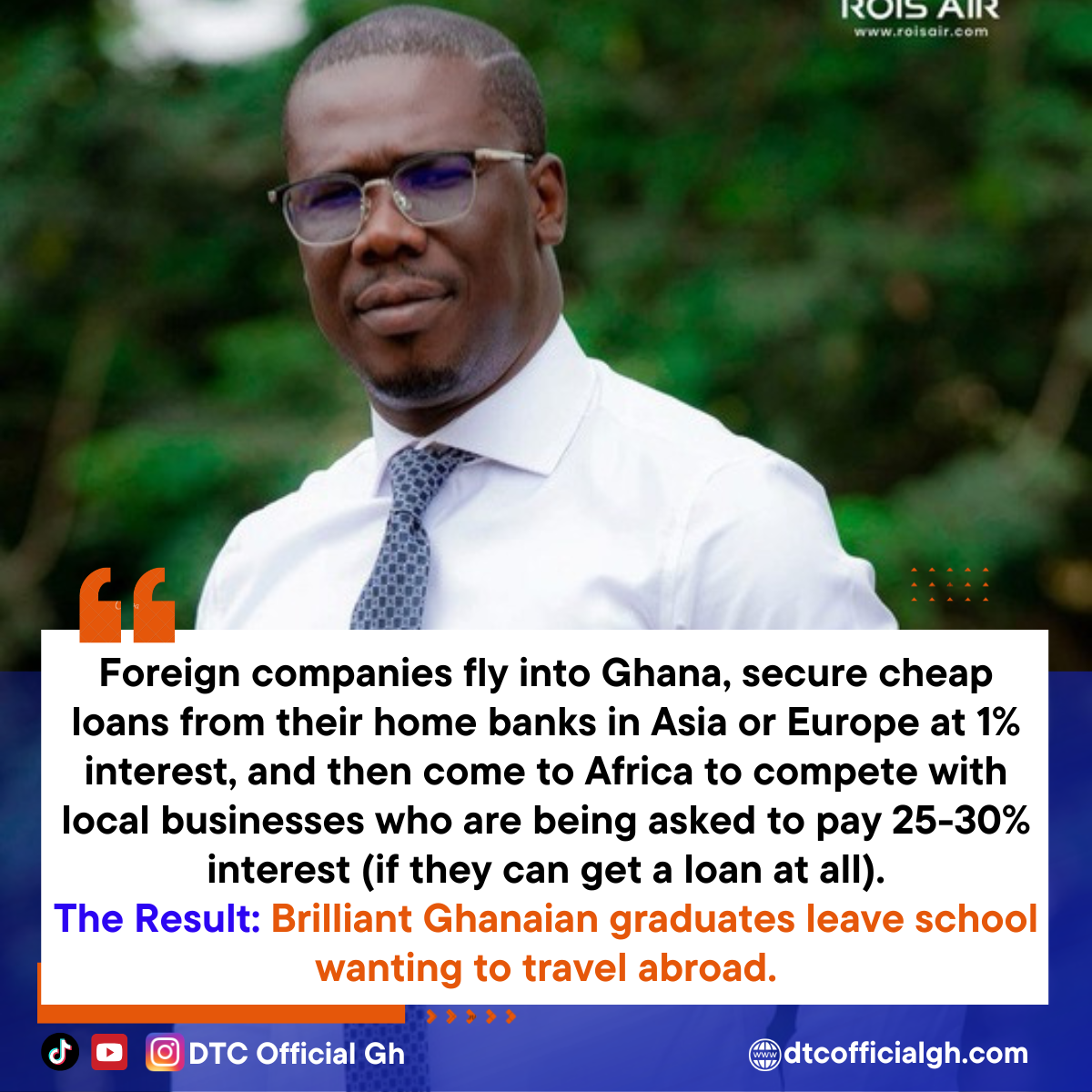
Here is the painful reality he painted: Foreign companies fly into Ghana, secure cheap loans from their home banks in Asia or Europe at 1% interest, and then come to Africa to compete with local businesses who are being asked to pay 25-30% interest (if they can get a loan at all).
“There is no way you can compete with those people. None. Never.”
The Result: Brilliant Ghanaian graduates leave school wanting to travel abroad. Why stay to build a business when the financial system is designed against you?
The Ambassador’s prescription is bold but simple: African banks and governments must rethink their lending models. If students were supported in school and entrepreneurs were backed with affordable capital, the “brain drain” would slow, and the “brain gain” would begin.
Read Also: Unlocking Africa’s Trade and Fintech Potential: A Conversation with Nick Murphy
The Final Verdict
This conversation wasn’t about bashing Africa; it was about awakening it. Ambassador Rois is an optimist. He believes AfCFTA is moving in the right direction, even if progress isn’t visible on the streets yet.
But the clock is ticking. Asia didn’t get here by accident. They built systems for intra-regional trade, they supported their human capital, and they made capital affordable for their own people.
The question for Africa is simple: Will we continue to chase dollars abroad while our neighbors struggle, or will we finally learn to trade with the man next door?
For more insights and inspiring stories , kindly follow us on Twitter and WhatsApp for more.
A huge thank you to H.E. A.B. Paskal Rois for his time and honesty. Watch the full interview on YouTube here.



If you cast your eyes around Europe, America to Asia, they’re doing a Policy Rate of about 0,1,2,3,…to 6.5% whereas Africa boosts 25 to 30% Policy Rate why won’t we lose our market to the foreigners?
I don’t even understand how I finished up right here, however
I thought this post used to be great. I don’t recognize who you might be but certainly you’re going to a well-known blogger
for those who are not already. Cheers!