Why Western Propaganda on Iran Fails the Test of Orientalism
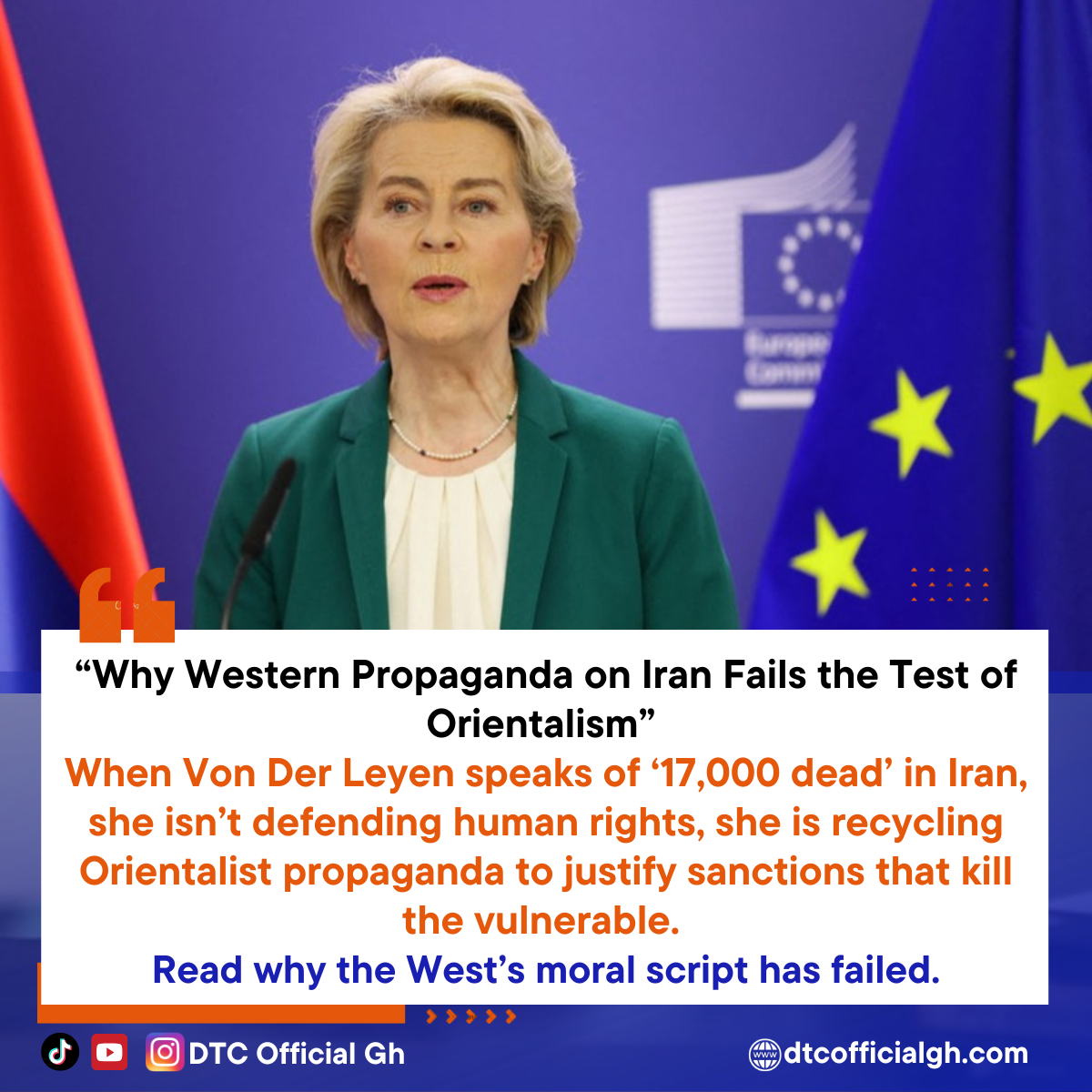
When European Commission President Ursula von der Leyen recently argued against lifting sanctions on Iran, she framed her case in the familiar language of moral absolutism. “Iran has killed 17,000 people,” she stated, referencing protests in 2022-2023, while also invoking broader claims about executions and political repression. On its surface, this appears to be a defense of universal human rights. But beneath the rhetoric lies a deeper, more problematic structure, one that Orientalist theory helps expose.
For decades, Western policymakers have wielded “human rights” as a geopolitical cudgel against nations that resist Western hegemony. Iran, a perennial target, is portrayed as a pre-modern, violent, and irrational “Other” in need of civilizational correction. Yet this narrative collapses under scrutiny. The failure of Western propaganda on Iran is not a failure of facts, it is a failure of framing, rooted in a centuries-old habit of dehumanization.

The Orientalist Blueprint
Edward Said’s Orientalism (1978) argued that Western representations of the Middle East are not neutral observations but self-serving constructions. The “Orient” is depicted as despotic, fanatical, and backwards, the inverse of Western self-image as democratic, rational, and humane. This binary serves a political function: it justifies intervention, sanctions, and regime change as benevolent acts of liberation.
Von der Leyen’s comments fit squarely into this tradition. The claim of “17,000 dead” is presented without context, no mention of Western-backed economic warfare (sanctions) that have denied Iranians access to medicines, nor of armed insurgent groups funded abroad. More importantly, the figure itself, derived from opposition sources, is hotly disputed. Independent assessments suggest lower numbers, but precision is not the point. The number’s rhetorical power lies in its shock value, reinforcing the image of Iran as a uniquely brutal state.
READ ALSO: “We Are Not Talking About Competition” The Brutal Truth About Ghana’s Financial Trap
Selective Outrage and Structural Hypocrisy
If Western elites genuinely prioritized human rights, one would expect proportionate outrage at allies with far worse records. Saudi Arabia’s war in Yemen has killed hundreds of thousands, yet von der Leyen’s Commission has sold arms to Riyadh. Israel’s military operations in Gaza and the West Bank have killed over 35,000 people since October 2023 alone, according to local health authorities, many of them women and children. Where is the equivalent call for sanctions?
The Orientalist framework explains this selectivity. Iran is a sovereign state that resists Western diktat, supports anti-colonial movements (from Hezbollah to Hamas), and refuses to subordinate its foreign policy to Washington or Brussels. Thus, Iran must be demonized. The “human rights” language is not a universal standard but a weapon of geopolitical discipline.
What the Propaganda Ignores
The Western narrative routinely erases Iranian agency, complexity, and achievements. Iran has one of the highest literacy rates in the region, a vibrant civil society, and regular elections, imperfect by Western standards but far from the caricature of total darkness. Moreover, many Iranians reject the assumption that lifting sanctions would harm their cause. On the contrary, sanctions have crippled the economy, increased poverty, and weakened the middle class, the very social base that might drive democratic change.
For more insights and inspiring stories, kindly follow us on Twitter and WhatsApp.
By demanding permanent sanctions in the name of human rights, von der Leyen and her peers are advocating for collective punishment: denying an entire nation of 85 million people access to global trade, medicine, and travel. Under international law, this is a form of coercion that potentially violates human rights far more than the abuses it claims to remedy.

The Failed Gospel
Why has this propaganda failed? Because an increasing global majority, in the Global South as well as among critical Western publics, sees through the double standard. The war in Ukraine produced swift sanctions and moral clarity; the war in Gaza exposed the West’s selective empathy. When the same voices that cheered for Ukrainian sovereignty now cheer for crippling an entire Iranian population, the word “hypocrisy” becomes too mild.
Orientalism ultimately fails because the “Orient” talks back. Iranian journalists, activists, and ordinary citizens have taken to social media to document the real effects of sanctions: cancer patients dying without chemotherapy, children suffering from malnutrition. They make their own moral claims and reject being turned into props in Western political theater.
READ ALSO: How China Just Overtook America as the Defender of Global Order
Conclusion
Ursula von der Leyen may believe she is speaking truth to power. In reality, she is reciting a script written in the 19th century, updated with press releases and casualty figures, but unchanged in structure. True human rights advocacy would demand consistency, verification, and respect for Iranian sovereignty and dignity. It would challenge sanctions as a blunt instrument that harms the vulnerable the most. Until then, the Western human rights campaign on Iran will remain what it has always been: a mirror in which the West sees its own virtue, not a window into Iranian reality.
And the world is no longer fooled.
For more insights and inspiring stories, kindly follow us on Twitter and WhatsApp.