
“We Are Not Talking About Competition” The Brutal Truth About Ghana’s Financial Trap
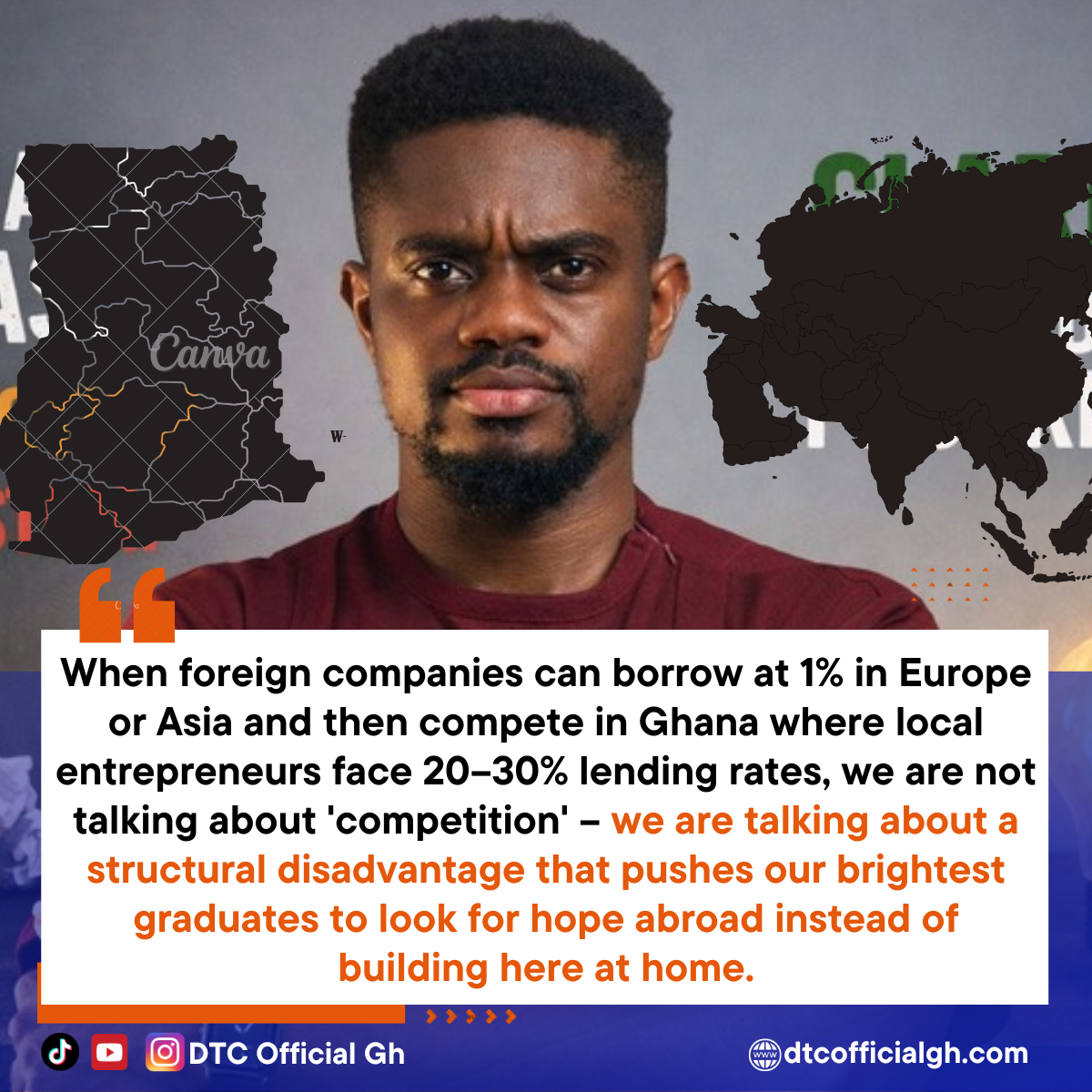
Caleb Apedoh said what many of us have been afraid to say out loud.
When I shared my conversation with Indonesian Ambassador H.E. A.B. Paskal Rois, the comments on LinkedIn kept me up at night. But one, from Caleb Apedoh, cut deeper than the rest.
“When foreign companies can borrow at 1% in Europe or Asia and then compete in Ghana where local entrepreneurs face 20–30% lending rates, we are not talking about ‘competition’ – we are talking about structural disadvantage that pushes our brightest graduates to look for hope abroad instead of building here at home.”
Let me repeat that: We are not talking about competition.
We are talking about a rigged game. And until we name it for what it is, we will keep losing our best minds and our best opportunities.

The Uneven Playing Field Nobody Wants to Fix
Caleb isn’t an economist sitting in an ivory tower. He’s observing what happens every single day.
- A European company borrows at 1%, flies capital to Ghana, and sets up shop.
- A Ghanaian entrepreneur walks into a local bank and is offered 25–30% – if they are approved at all.
- The foreign company wins the contract. The local business closes. The graduate who could have worked for the local firm now updates their CV for London, Toronto, or Berlin.
This isn’t a failure of effort. It’s a failure of design.

Caleb’s Three Questions That Demand Answers
Caleb didn’t just complain. He proposed a way forward. And I am now putting these questions directly to our policymakers, bankers, and business leaders:
1. Where are the dedicated low-interest credit windows for Ghanaian SMEs?
We have the Ghana Export-Import Bank (GEXIM). We have the Development Bank of Ghana (DBG). We have international DFIs such as the World Bank and the AfDB. So why is a young Ghanaian founder still paying 30% interest while a foreign competitor pays nearly nothing?
Caleb’s ask: Government and DFIs must back low-interest windows specifically for local SMEs. Not loans that require collateral, no young person has. Real access. Real rates.
For more insights and inspiring stories, kindly follow us on Twitter and WhatsApp.
2. Why aren’t we forcing foreign investors to partner with local firms?
Right now, a foreign company can come in, set up fully, hire a few locals at entry level, and take all the profit home. That’s not investment – that is extraction.
Caleb’s ask: Incentivize (or require) foreign investors to form joint ventures with Ghanaian businesses. If they want access to our market, they must bring our people along – not as junior employees, but as real partners.
3. Where is the link between investment incentives and real knowledge transfer?
We give tax breaks, land, and customs exemptions to foreign companies. What do we get in return? Often, not enough.
Caleb’s ask: Tie every incentive to measurable knowledge transfer and decent jobs for young graduates. If a foreign company hires a Ghanaian graduate, that graduate should leave after three years with skills that could enable them to start their own business, not just a paycheck.
READ ALSO: Wealth Is Not a Mystery: 5 Practical Steps to Build Real Financial Resilience
The Question We Must Face
Caleb ended his comment with something that has stuck with me:
“Because until we fix the rules of the game, aren’t we basically telling talented Ghanaian youth that their only realistic option is to leave?”
Read that again.
Every young Ghanaian who packs their bags for the airport isn’t just chasing dollars. They are responding to a system that has, silently and systematically, told them: You cannot win here. The game is not for you.
And yet, we wonder why there is brain drain. [Michelle speaks about Brain Drain versus Brain Gain]
We wonder why the entrepreneur who could have built the next great Ghanaian brand is now driving a taxi in Canada.
We wonder why the nurse who could have saved lives in Accra is now working in a London hospital.
READ MORE; Exposure Is Not Enough: How Long, and To What?”
This Is Not Hopeless, But It Requires Urgency
Caleb used the word “emergency.” I agree.
This is not a problem for another task force. Another committee. Another five-year plan.
This is a problem that requires:
- Policymakers willing to redesign credit systems
- Bankers willing to take calculated risks on local talent
- Business leaders are willing to demand partnership over extraction
- Young Ghanaians are willing to stay, but only if we give them a reason to
The Ambassador told us Asia is winning because they trade among themselves and support their own. Caleb is telling us that until we fix the financial architecture, all the trade agreements in the world won’t matter.
For more insights and inspiring stories, kindly follow us on Twitter and WhatsApp.
But I want to hear from you first:
- Have you experienced this lending trap as an entrepreneur?
- Have you left Ghana, or thought about leaving – because the system felt impossible?
- What would it take for you to stay and build here?
Drop your answer in the comments. I will read every single one and react to them on our youtube channel.
And to Caleb Apedoh, thank you for saying what needed to be said.
Read the original interview with Ambassador H.E. A.B. Paskal Rois here: Why Asia Is Winning & Business Lessons Africa Must Learn
Follow the LinkedIn conversation that sparked this post.
WATCH THE FULL INTERVIEW BELOW;


3 Responses
[…] BUSINESS READ: “We Are Not Talking About Competition” The Brutal Truth About Ghana’s Financial Trap […]
[…] READ ALSO: “We Are Not Talking About Competition” The Brutal Truth About Ghana’s Financial Trap […]
[…] READ ALSO: “We Are Not Talking About Competition” The Brutal Truth About Ghana’s Financial Trap […]