Can We Stay Culturally Connected in a High-Tech, High-Pressure World?
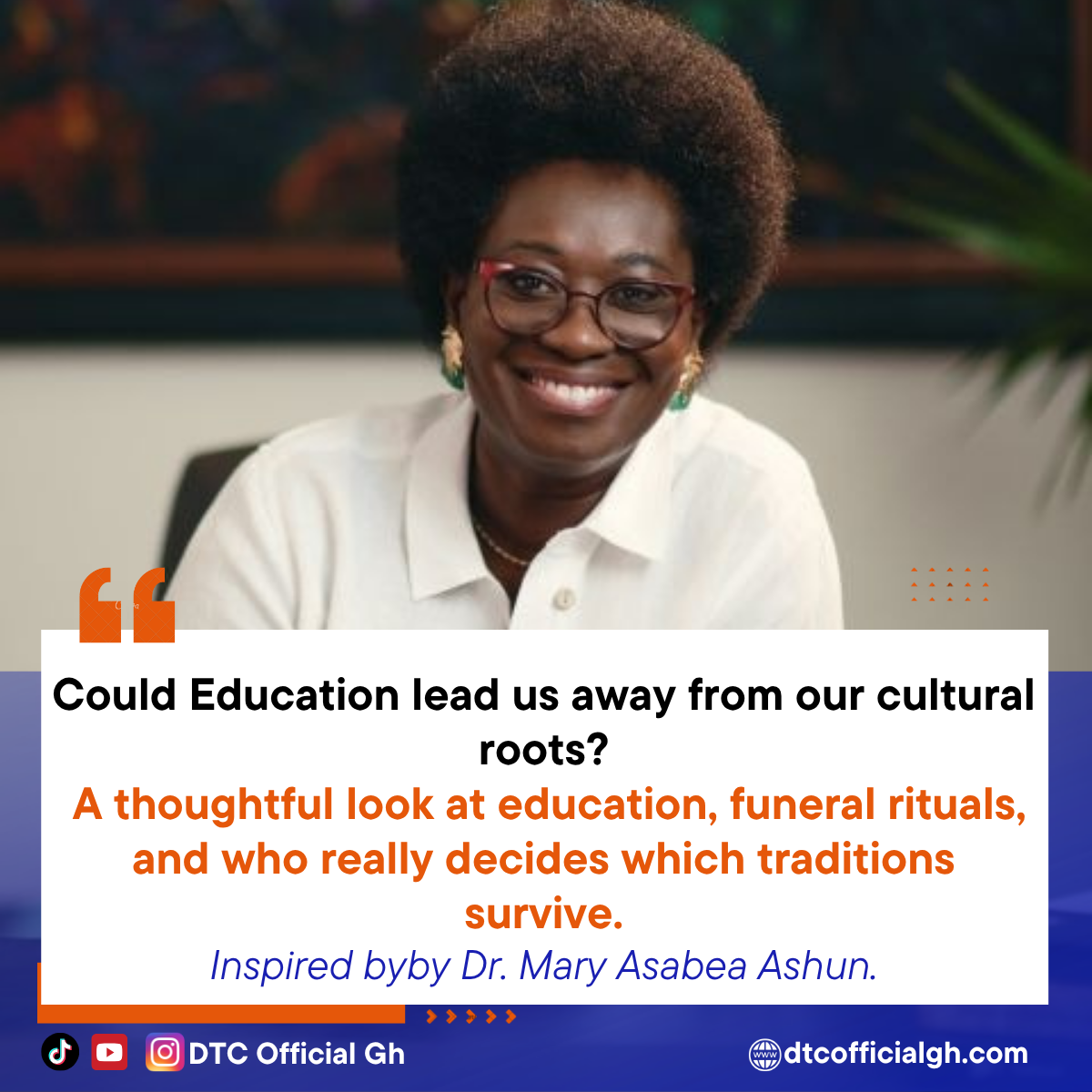
Subtitle: A thoughtful look at education, funeral rituals, and who really decides which traditions survive.
If you’ve ever driven home from a family funeral, especially one in your hometown, and found yourself unusually quiet, you’ll understand the heart of this post. You saw the rituals. You heard the songs. You donated the money. And yet, somewhere between the graveside and the highway, a small voice asked: Do I still believe in all of this?
That’s not rebellion. That might be education.
Dr. Mary Asabea Ashun, in a recent essay, puts her finger on a question many of us feel but rarely say out loud: Is our desire for higher education quietly loosening our ties to our own culture?

The Education Paradox
We all want our children to be educated. In Ghana, across Africa, and around the world, parents sacrifice enormously to give the next generation what they didn’t have: better schools, more degrees, sharper critical thinking.
But here’s the paradox: critical thinking, by design, questions everything, including tradition.
As Dr. Ashun notes, higher education teaches us to think for ourselves. And once you start thinking for yourself, you might look at a centuries-old funeral custom, taking out a bank loan to host a lavish send-off, and wonder:
Is this still meaningful? Or is it just an expensive tradition?
That’s not disrespect. That’s reflection.
For more insights and inspiring stories, kindly follow us on Twitter and WhatsApp.
The Funeral in the Rearview Mirror
Let’s stay with that funeral for a moment.
In Ghana, funerals are profound cultural events. They are expensive, community-bound, and emotionally heavy. The practice of donating money, whether physical cash or mobile money, is meant to support the bereaved. It’s beautiful in intention.
But Dr. Ashun offers a striking image: during a major internet outage in March 2024 that affected 13 African countries, mobile money donations at funerals ground to a halt. The panic was palpable.
That moment reveals something. We are already living in two worlds: one of ancestral ritual, and one of fiber-optic cables. And when those worlds clash, we have to ask, what is this tradition actually for?
BUSINESS READ: “We Are Not Talking About Competition” The Brutal Truth About Ghana’s Financial Trap
Learning Culture vs. Living Culture
Here’s where the blog post gets practical (and a little uncomfortable).
Dr. Ashun asks a bold question:
Are we teaching children cultural norms just so they can discard them later?
Think about it. We teach folktales, drumming, libation, funeral protocols, and respect for elders. But if a well-educated young adult quietly stops participating in rituals they no longer find meaningful, have we failed? Or have they simply… evolved?
She offers a brilliant analogy: the slide rule gave way to the calculator. Not because the slide rule was bad, but because something more useful arrived.
Does culture work the same way? Not entirely. Because culture isn’t a tool. It is identity. It’s belonging. It’s the story of who we are. So we can’t simply “update” culture like software. But we also can’t freeze it in time.
READ ALSO: “Intentionality Over Hype: Emmaline Datey’s Bold Advice for the Next Generation”

Who Is Responsible?
This is my favorite part of Dr. Ashun’s argument: responsibility is shared.
- Families plant the first seeds of cultural identity.
- Communities water them through festivals, funerals, and daily life.
- Schools either strengthen or weaken those roots.
But here’s the hard truth for educators: the school timetable is already bursting. Math. Science. Languages. Exams. Where does “critical reflection on funeral donations” fit in?
Dr. Ashun doesn’t pretend this is easy. She simply argues that if we don’t make space for this conversation, in classrooms, in homes, in public discourse, then cultural transmission becomes either indoctrination or nostalgia. Neither serves the next generation.
A Way Forward (Without Romanticizing the Past)
So what do we actually do?
- Teach culture with honesty. Don’t pretend every tradition is sacred or unchanging. Explain why it existed. Then ask: Does it still serve us?
- Allow young people to adapt. If a well-educated adult chooses to modify a ritual, smaller funeral, digital donation, or shorter ceremony, that’s not betrayal. That’s culture alive.
- Make room in the timetable. Even one debate per term: “Should funeral practices change?” That’s not lost time. That’s identity work.
- Stop shaming the questions. The moment a child asks, “Why do we do this?” is not a crisis. It’s a beginning.
Final Reflection
Dr. Ashun ends her essay with a beautiful, honest admission: we have to honor culture and fit it into an already busy life. There’s no perfect answer. But there is a better question than “How do we preserve everything?”
The better question is: How do we raise young people who are rooted enough to belong, and free enough to grow?
If we can hold that tension, without panic, without guilt, then maybe culture doesn’t die. It breathes.
Inspired by the essay “Could Education lead us away from our cultural roots?” by Dr. Mary Asabea Ashun.
Dr. Mary Asabea Ashun: Transformational CEO | Africa Education Medal Finalist | Strategy Architect & Systems Builder | Cross-Sector Leadership (Africa & North America)