
Oliver Barker-Vormawor’s Bold Take on Power, Hope, and Neocolonial Influence
In the latest episode of DTC OfficialGh, host Amin Mohammed sat down with the outspoken lawyer and human rights activist Oliver Barker-Vormawor, Esq., to unpack Africa’s democratic struggles, the wave of military takeovers in West Africa, and the enduring shadow of neocolonialism. The conversation was a powerful reminder that the soul of democracy in Africa rests not in political slogans, but in the courage of its citizens and the integrity of its institutions.

Has Democracy Failed Africa?
When asked if democracy has failed the continent, Barker-Vormawor challenged the very premise of the question.
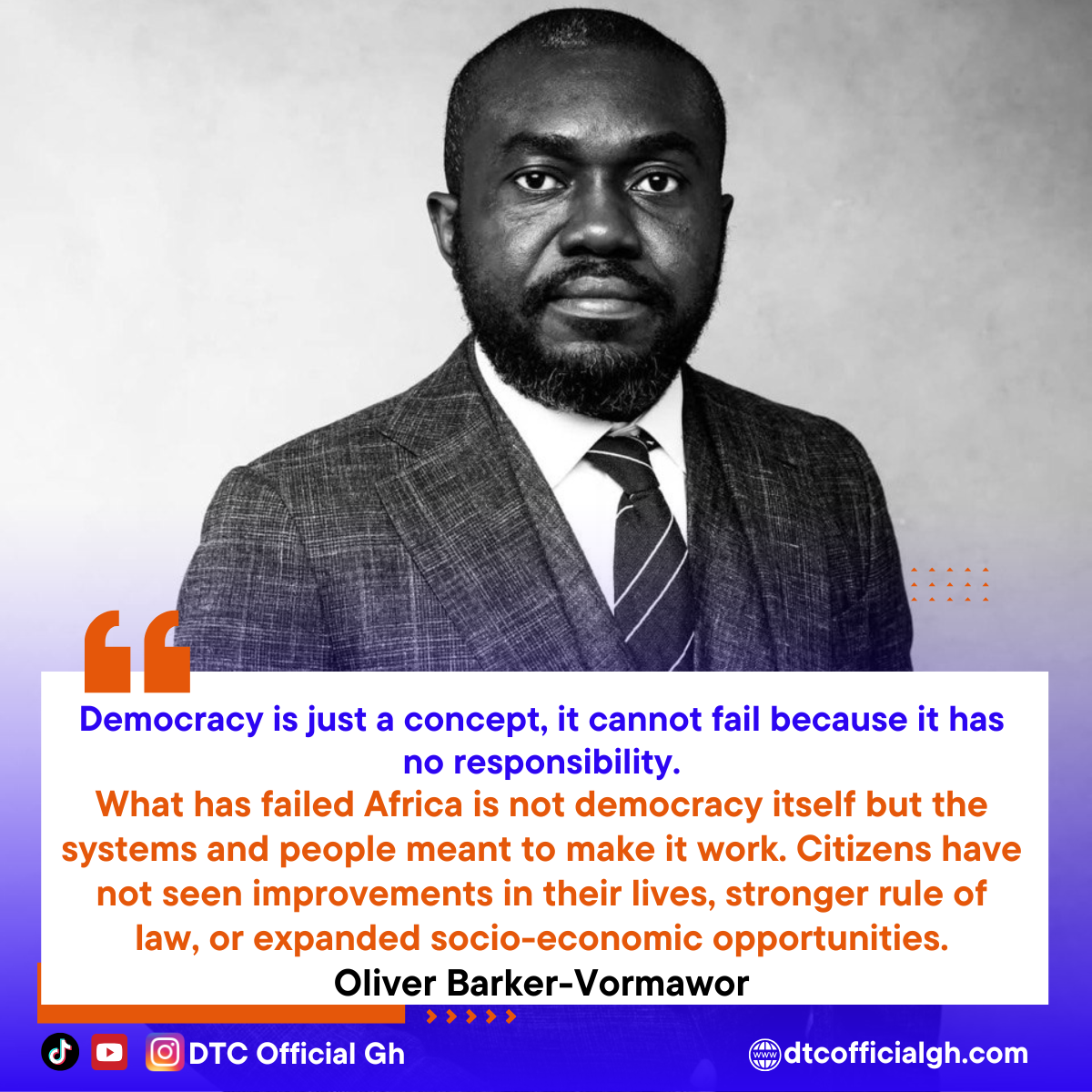
“Democracy is just a concept, it cannot fail because it has no responsibility,” he said.
What has failed, he argues, is not democracy itself but the systems and people meant to make it work. Citizens have not seen improvements in their lives, stronger rule of law, or expanded socio-economic opportunities.
The failure, therefore, lies not in the idea of democracy, but in the inability of African states to “engineer a model” that translates the promise of governance into tangible progress. Both leaders and citizens share that duty, and both have fallen short.
READ ALSO: Okyeame Kwame Calls for a Cultural Reset: Bridging the Rift Between Media and the Arts
Between Despair and Hope
Amin steered the conversation toward the future, asking whether young Africans can find hope in the midst of widespread political disillusionment. Barker-Vormawor’s answer was sharp but reflective:
“Our lives are torn between despair and desperation… but hope, even when unrealistic, keeps us alive.”
He emphasized that hope must lead to action. Despair paralyzes; hope mobilizes. “Hope is only useful if it becomes the beginning of change,” he added.
READ ALSO: We Will Set a Standard No Government Can Reverse” – President Mahama Vows
The Question of Neocolonialism
On the topic of foreign influence and neocolonial control, especially through political party financing, Barker-Vormawor didn’t mince words.
“You can’t justify corruption or unethical behavior by poverty,” he said.
He noted that while global power structures still exploit African economies, the deeper crisis lies within, public dishonesty and a lack of ethical grounding in leadership. Even when leaders are well-paid, greed can still drive misconduct.
“Without a strong ethical value system,” he warned, “no reform can stop corruption.”
True independence, he argued, begins with building internal standards and consistently enforcing them. “If we agree that a public officer spraying cash in public is unethical, then we must demand their resignation,” he said firmly.
For more insights and inspiring stories, kindly follow us on Twitter and WhatsApp.
The Heart of a True Democracy
When asked what he would prioritize if given the chance to lead a country, Barker-Vormawor’s answer cut straight to the foundation of governance:
“Every democracy requires the ability to look power in the face and say, ‘I disagree.’”
He stressed that any system that suppresses dissent is bound to fail. “Power abhors constraints,” he said. “We must design systems that consistently audit and restrain power, because no person is so good that they need no accountability.”
A Closing Reflection
As the conversation drew to a close, Amin recalled one of Barker-Vormawor’s earlier remarks, that Ghanaians, and by extension Africans, are often “built inwardly with fear.” That fear, he suggests, must be unlearned if true democracy is to take root.
This conversation is not just about politics; it’s about identity, courage, and the collective will to redefine leadership in Africa.
Watch the full episode for a deeper dive into Africa’s democratic struggles and the way forward:



1 Response
[…] MUST READ: Oliver Barker-Vormawor’s Bold Take on Power, Hope, and Neocolonial Influence […]