
Five Technology Issues to Watch Out For in 2026
Written by: Samuel Sasu Adonteng, Peter Kwasi Kodjie, Margaret Edem Gasu & Rexford Akrong.
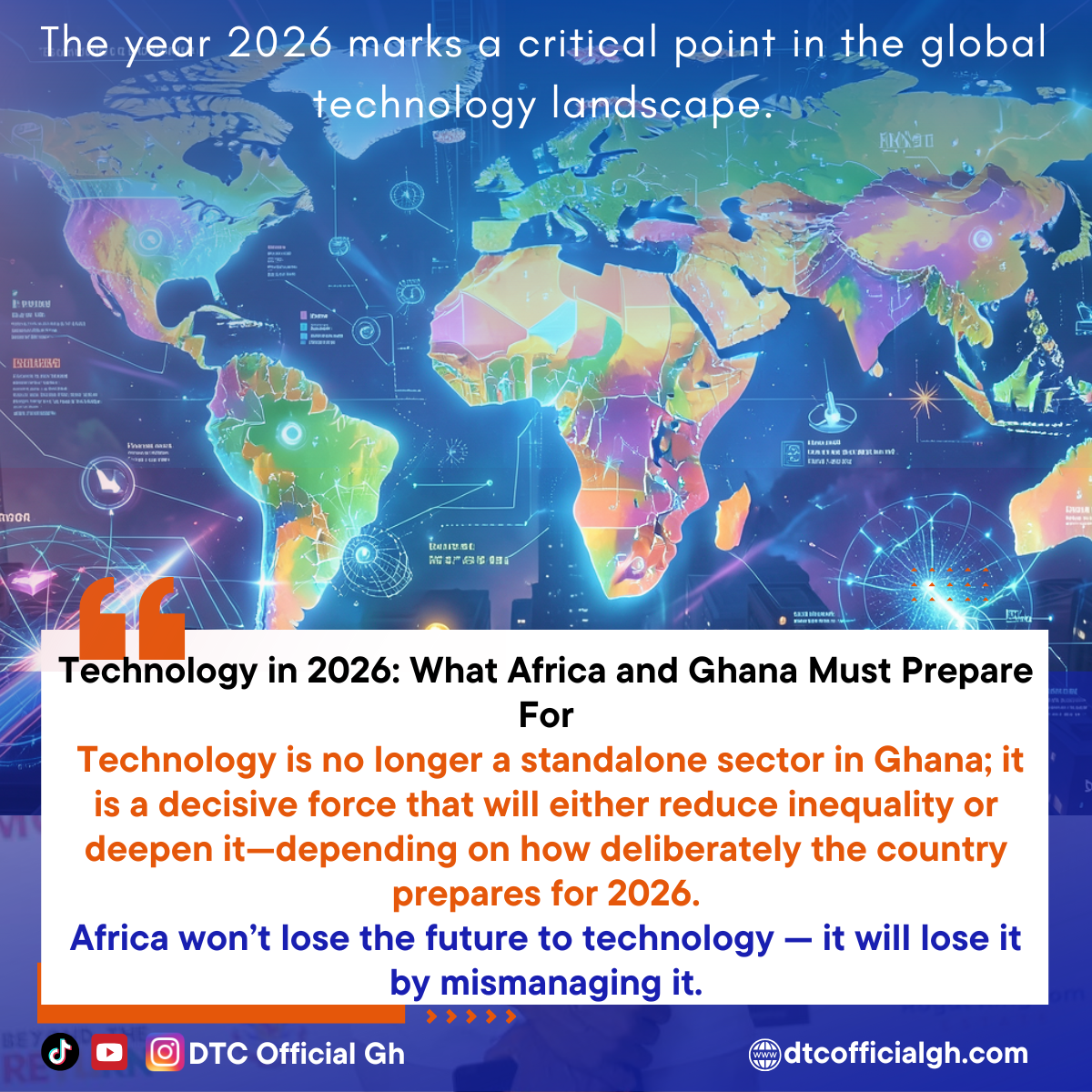
The year 2026 marks a critical point in the global technology landscape. Rapid advances in artificial intelligence, digital finance, connectivity, climate technologies, and cybersecurity are no longer unfolding at the margins of society but are reshaping the core of economies, institutions, and everyday life. According to the World Economic Forum and the World Bank, these technological shifts are redefining how people work, access services, manage resources, and participate in the digital economy; often at a pace that outstrips policy, infrastructure, and skills development.
For developing economies, particularly in Africa, these changes present a dual reality: unprecedented opportunities for leapfrogging traditional development barriers, alongside heightened risks of exclusion, job displacement, and digital vulnerability if transitions are poorly managed. Ghana, with its growing digital ecosystem and youthful population, stands at the centre of this moment.
This article highlights five key technology issues to watch out for in 2026, drawing on verifiable data and insights from leading global and African institutions, including the World Economic Forum, the World Bank, the African Union, and Smart Africa. Beyond identifying global trends, the analysis situates them within Ghana’s development context, focusing on five priority sectors – employment, health, education, fintech, and agriculture. These sectors have been chosen for their central role in economic resilience, human development, and inclusive growth. Together, these sectors represent both the greatest exposure to technological disruption and the strongest potential for transformative impact if technology is strategically harnessed.
For more insights and inspiring stories, kindly follow us on Twitter and WhatsApp.

1. Artificial Intelligence and Automation Transforming Work
Artificial Intelligence is revolutionizing economies and the nature of work. Advancements in AI – from generative AI chatbots to robotics – are driving productivity and innovation across industries. However, they also bring disruption to labour markets. The World Economic Forum projects that about 69 million new jobs will be created by emerging tech (like AI and the green transition) in the next five years, but 83 million could be eliminated by automation and other pressures, meaning roughly one-quarter of jobs worldwide will be disrupted by 2027. This shift makes upskilling and reskilling more critical than ever; governments and businesses are urged to foster a culture of lifelong learning to help workers adapt. In Africa, the stakes are high given the continent’s young workforce – the World Bank estimates 230 million jobs in Africa will require digital or AI skills by 2030. Forward-looking organizations and governments are investing in AI strategies and training. The goal is to harness AI for economic growth (such as new digital services and improved efficiency) while managing its impact on employment. In 2026, AI is not just a tech trend but a transformative force reshaping how we work, demanding proactive policies on education, job transition, and ethical AI use.
2. Cybersecurity and Data Privacy in a Hyperconnected Era
Cyber threats are escalating, making cybersecurity and data privacy top priorities. As businesses, governments, and individuals conduct more of their activities online, cyber-attacks have grown in frequency and sophistication globally. Data breaches and ransomware target not only corporations but also critical infrastructure and personal data, posing severe economic and security risks. In fact, cybercrime is on track to cost the world trillions of dollars annually (estimated at $10.5 trillion per year by 2025). Africa is not spared – the continent’s rapid digitalization has exposed vulnerabilities. A recent UN Economic Commission for Africa report suggests Africa may already be losing around 10% of its GDP to cyberattacks and digital fraud, a startling figure underscoring the need for action. Meanwhile, governments are stepping up efforts on data protection: many African countries have enacted data privacy laws, and the African Union’s Malabo Convention on cybersecurity is pushing for higher standards, though implementation remains uneven. In 2026, organizations will be expected to invest more in cyber resilience – from zero-trust security architectures to AI-driven threat detection – and to train skilled cybersecurity professionals. Protecting user data and privacy is equally paramount as digital services expand.
READ ALSO: What This Moment Means for Africa
3. Connectivity and Digital Inclusion: Bridging the Divide
Bridging the digital divide remains a critical challenge and opportunity. Digital technologies have spread rapidly, but access to the internet and digital services is still far from equal. Globally, about 5.6 billion people (roughly 68% of the world’s population) were online by 2025, leaving an estimated 2.5+ billion people still offline. This gap is even more pronounced in Africa: internet penetration on the continent was only about 39% in 2023, compared to 87% in Europe. In other words, nearly two out of three Africans remain offline. The infrastructure coverage has improved – for example, over 76% of West Africa’s population is now under 4G coverage – but usage lags behind. Key barriers include affordability and digital literacy. On average, mobile internet in Africa costs about 4.6% of monthly income (well above the 2% affordability target), and entry-level smartphones can cost weeks of income for many families. Social factors also play a role: women in Africa are 35% less likely to be online than men, reflecting gender gaps in access. To close this divide, there should be renewed commitment from governments and private actors. There’s a push for digital public infrastructure – affordable broadband, public Wi-Fi, digital IDs, and payment systems – to increase adoption. International partners (World Bank, African Union, etc.) are supporting programs in digital skills training and affordable devices to ensure more people, especially in developing countries, can participate in the digital economy. Bridging the connectivity gap is not just a social imperative; it will unlock new markets, talent, and innovations by bringing the next billion users online.
4. Fintech and the Digital Economy Revolution
Financial technology (fintech) is revolutionizing banking, inclusion, and commerce. The fintech sector continues its rapid growth as more people and businesses adopt digital finance solutions. From mobile payment apps and online banking to cryptocurrencies and crowdfunding, technology is transforming how we manage money. Globally, 79% of adults now have some form of financial account, a figure that has risen sharply thanks to mobile and digital banking innovations. Nowhere is this fintech leap more evident than in Africa, which has become the world’s leader in mobile money. Africa accounts for almost 70% of the world’s $1 trillion mobile money transactions, and in Sub-Saharan Africa, nearly 10% of GDP is transacted through mobile money services – far outpacing other regions. This has brought millions of “unbanked” people into the financial system, spurring entrepreneurship and reducing poverty. The fintech industry itself is booming: it’s now Africa’s fastest-growing start-up sector and is projected to reach $230 billion in value by 2025, growing 10% annually. Globally, fintech trends to watch in 2026 include the rise of central bank digital currencies (CBDCs) – over 80% of central banks are now researching or piloting digital versions of national currencies – and the expansion of open banking, which allows consumers to securely share financial data across services to get better rates and personalized products. Digital finance is also enabling faster cross-border remittances and new forms of credit for small businesses through alternative data. For consumers and businesses alike, fintech is making financial services more accessible, efficient, and tailored. Regulators, meanwhile, are working to keep pace, updating policies on digital payments, crypto-assets, and consumer protection to ensure stability and trust in this fast-moving digital economy.
5. Green Tech and Climate Innovation for Sustainability
Technologies for climate resilience and sustainable development are gaining urgency. With climate change’s impacts intensifying – global average temperatures hit record highs in 2024, accompanied by a slew of extreme weather events – there is a spotlight on “green” technology solutions. These range from clean energy to climate-smart agriculture. Governments and industries are investing in renewable energy technologies like solar, wind, and battery storage to transition away from fossil fuels; notably, world leaders (G20) even committed to triple global renewable energy capacity by 2030 in recent agreements. Equally important are technologies that help societies adapt to climate impacts. Climate-tech innovation in 2026 will include advanced climate forecasting, flood and drought early-warning systems, and new materials for resilient infrastructure. In agriculture, which is especially critical for Africa, digital technology is a game-changer. By integrating AI, remote sensing (satellite imagery), and data analytics, farmers can optimize planting and irrigation, use predictive tools for weather and pests, and thus transform traditional farming into a more productive and climate-smart system. This is vital because agriculture remains the backbone of livelihoods in many developing countries – for example, it employs over half of Africa’s workforce and a significant share of Ghana’s as well. We are also seeing growth in the “circular economy” tech that reduces waste, such as recycling innovations and bio-engineered alternatives to plastics. Meanwhile, green financing is rising to support these innovations; global investment in climate adaptation and mitigation technologies continues to grow year-on-year. In 2026 and beyond, expect technology to be at the forefront of efforts to combat climate change – whether through cutting emissions (clean tech) or boosting resilience (agritech, water-tech, etc.). These solutions not only protect the planet but also create new economic opportunities in sustainable industries.
For more insights and inspiring stories, kindly follow us on Twitter and WhatsApp.
Ghana: How These Trends Affect Key Sectors
Ghana, we will need to closely monitor and embrace these technology trends to advance Ghana’s socio-economic resilience. In line with Ghana’s digital transformation goals, five priority sectors – Employment, Health, Education, Fintech, and Agriculture – stand to be significantly impacted:
Employment
Digital technology presents both risks and opportunities for employment in Ghana. While automation and AI threaten to disrupt certain job categories, the digital economy also offers significant potential for job creation if skills development keeps pace with global trends. In response, the government has introduced initiatives such as the One Million Coders Programme, aimed at equipping young people with basic coding and ICT skills. While this is a positive starting point, there is growing concern that such programmes may be insufficiently aligned with the direction in which technology and labour markets are moving. As AI becomes embedded across sectors, skills demand is shifting beyond basic coding toward a deeper understanding of AI systems, data literacy, machine learning concepts, responsible AI use, and applied skills such as prompt engineering, human-AI collaboration, and AI-assisted problem-solving. This underscores the need for a more coordinated and future-ready national skills strategy, one that actively engages private-sector employers, technology firms, startups, universities, and innovation hubs to deliver practical, demand-driven training. Such an approach should prepare individuals not only for employment but also for digital entrepreneurship, freelancing, and AI-enabled enterprise creation. Without clear pathways from training to income generation, regular curriculum updates, and stronger public-private collaboration, well-intentioned skills programmes risk becoming outdated before they achieve meaningful labour-market impact.
Health
Technology-driven innovation is improving healthcare access and outcomes in Ghana. A striking example is the use of drones to deliver medical supplies to remote clinics – a service that has dramatically cut delivery times for blood, vaccines, and medications. A recent study in Ghana’s Ashanti region showed that facilities served by medical drone deliveries saw maternal death rates drop by 56.4% after implementation, an indicator of how life-saving this tech can be. Beyond drones, Ghana’s health sector is adopting telemedicine platforms to connect patients in underserved areas with urban medical specialists, reducing the need to travel for care. Digital health records and mobile health apps are being introduced to streamline patient information and remind people to take medications or attend check-ups. Notably, Ghana is also leveraging its fintech prowess for health financing: mobile money platforms and insurance innovations are enabling more Ghanaians to save and pay for health services digitally, easing the burden of out-of-pocket expenses. By investing in these e-health solutions, Ghana aims to achieve more inclusive and efficient healthcare, aligning with the country’s efforts toward Universal Health Coverage.
READ ALSO: AI and quantum could unleash revolutionary societal changes
Education
In Ghana’s education sector, digital technology is playing an increasingly pivotal role. The government and partners are integrating digital tools into classrooms to enhance teaching and learning. For instance, there are programs equipping schools with computers and internet connectivity, and training teachers in online pedagogies. This shift gained momentum after the COVID-19 pandemic and continues in 2026 with blended learning models. However, challenges persist – particularly the urban-rural divide in connectivity and resources. While cities enjoy fairly high internet coverage, many rural schools still struggle (reflecting the broader trend that only about 38–40% of West Africa’s population actually uses the internet despite much higher network coverage). To address this, initiatives like distance learning via radio, offline educational content, and public-private partnerships for school connectivity are underway. Ghana is also emphasizing digital literacy and coding in the curriculum, recognizing that tomorrow’s jobs will require tech proficiency. By prioritizing education technology (EdTech) and closing the digital gap, Ghana seeks to empower its students with 21st-century skills. These efforts will help produce graduates who can actively participate in the digital economy, driving innovation and growth in the long run.

Fintech
Fintech is a bright spot in Ghana’s development, mirroring the wider African boom in digital finance. Ghanaians have rapidly adopted mobile money and other digital financial services – using them for everything from everyday payments to business transactions. This has greatly advanced financial inclusion. For example, farmers and traders in remote areas can safely transact and save money via mobile wallets instead of cash. Ghana’s fintech ecosystem is also innovating in areas like peer-to-peer lending, e-commerce payments, and remittances. Crucially, the Bank of Ghana has been proactive: Ghana was among the first African countries to pilot a central bank digital currency (CBDC), known as the eCedi, to modernize the payment system. (As context, globally 86% of central banks are now exploring or testing CBDCs, and Ghana is at the forefront of this trend in Africa.) The eCedi pilot, alongside robust mobile money infrastructure, positions Ghana to have a very efficient digital payment landscape. Fintech growth is also attracting investment and startups to Ghana, contributing to job creation in tech and finance. To ensure stability, regulators are updating frameworks for things like consumer protection and cybersecurity in financial services. Overall, fintech is enabling Ghana to build a more inclusive and dynamic economy – one where a wide range of citizens and businesses can easily access credit, savings, and payment services, thus spurring entrepreneurship and reducing inequality.
Agriculture
Agriculture is critical for Ghana’s socio-economic resilience, employing a large portion of the population and contributing to food security and exports. Technology is increasingly seen as key to transforming this sector. Ghanaian farmers are beginning to embrace agritech solutions – for instance, using mobile apps to get market price information or weather forecasts via SMS, which helps them make better decisions on when and what to plant or sell. There are also efforts to introduce precision agriculture tools: some farms now use drones for crop monitoring or spraying, and sensor systems that monitor soil moisture to optimize irrigation. These innovations can significantly boost productivity and resource efficiency. Climate change makes tech adoption in agriculture even more urgent; irregular rainfall and new pest outbreaks threaten yields, so tools like climate-resilient seed varieties, satellite-based early warning systems, and AI-driven advisory services are invaluable. Given that agriculture still employs over 50% of Africa’s workforce on average (and a substantial share of Ghana’s), improving this sector has a broad development impact – higher incomes for farming communities, more stable food supplies, and opportunities for agro-processing industries. The Ghanaian government, recognizing this, has policies to support mechanization, digital extension services (e.g., advising farmers via mobile), and better rural connectivity. By harnessing technology in agriculture, Ghana aims to move from subsistence farming towards a more modern, sustainable agribusiness model that can withstand climate challenges and contribute to economic growth.
READ ALSO: Now AI Designs Websites in Minutes! Is It Game Over for Web Designers?
Conclusion
Taken together, the impacts of technology across employment, health, education, fintech, and agriculture point to a clear conclusion: technology is no longer a standalone sector in Ghana, but a foundational enabler of national resilience, productivity, and inclusion. Its transformative potential will only be fully realized if digital adoption is matched with strategic coordination, particularly in skills development, infrastructure expansion, regulatory readiness, and public-private collaboration. Ghana’s experience shows that when technology is purposefully aligned with development priorities, it can reduce inequalities, expand access to essential services, and unlock new economic opportunities. However, without continuous investment in advanced digital skills, responsible AI governance, and equitable access, especially for rural and marginalized communities, technological progress risks deepening existing divides. The central policy implication, therefore, is that Ghana must treat technology not merely as an innovation agenda but as a core pillar of socio-economic planning, embedding digital readiness into all sectors to drive sustainable growth, competitiveness, and long-term national development.
For more insights and inspiring stories, kindly follow us on Twitter and WhatsApp.
ABOUT THE AUTHORS:
Samuel Sasu Adonteng
Samuel Sasu Adonteng is the Chief Technical Officer at AASU and the Lead Programmes Officer for Education and Students’ Rights at AASU. He serves as the Union’s primary contact with UNESCO’s COVID-19 Global Education Coalition and the ECW Youth Sub-group. He specializes in quality assurance and innovation, with experience in facilitating multi-stakeholder dialogues. Samuel is dedicated to promoting social justice through initiatives focused on ending hunger, ensuring equal opportunities, and advancing human rights. He is a co-founder of the Ebibiman Tech Alliance, a tech startup focused on blending indigenous knowledge with technology.
ALSO FROM SASU: AI Is Coming for You- The Double-Edged Sword of Artificial Intelligence
Peter Kwasi Kodjie
Peter Kwasi Kodjie is the Coordinator of the Media and Website Unit of the University of Professional Studies, Accra. He has been an influential voice in the Tuning Africa Project Advisory Group (TAPAG) Phase II and the Harmonization of African Higher Education Quality Assurance and Accreditation (HAQAA3) Initiative. Peter serves on the Governing Council of the Magna Charta Observatory (MCO). Additionally, he is a founding member of the Global Student Forum (GSF) and a founding Trustee of the 100 Million Campaign. As a Steering Committee Member for the Youth Mobility for Africa Flagship Initiative and the CAPSI-MasterCard Foundation Project, Peter advocates for enhanced learning opportunities, youth empowerment, and climate justice.
Margaret Edem Gasu
Margaret Edem Gasu is a multidisciplinary professional working across technology, design, and public systems, with a strong focus on impact and people. She is a UI/UX designer and web developer operating at the intersection of design and technology. As the co-founder of Ebibiman, she is committed to building African-led innovation that blends culture, community, and impact. Grounded in faith and driven by purpose, she balances strategic thinking with creativity, always drawn to work that empowers people and builds systems that genuinely serve them.
Rexford Akrong
Rexford Akrong is an international development practitioner and a research manager at Education Sub-Saharan Africa, whose focus is on using evidence to support policy making on issues including youth and women employment and poverty reduction. His research interests are in youth employment, environment and natural resource management, and agricultural global value chains.


