
What This Moment Means for Africa
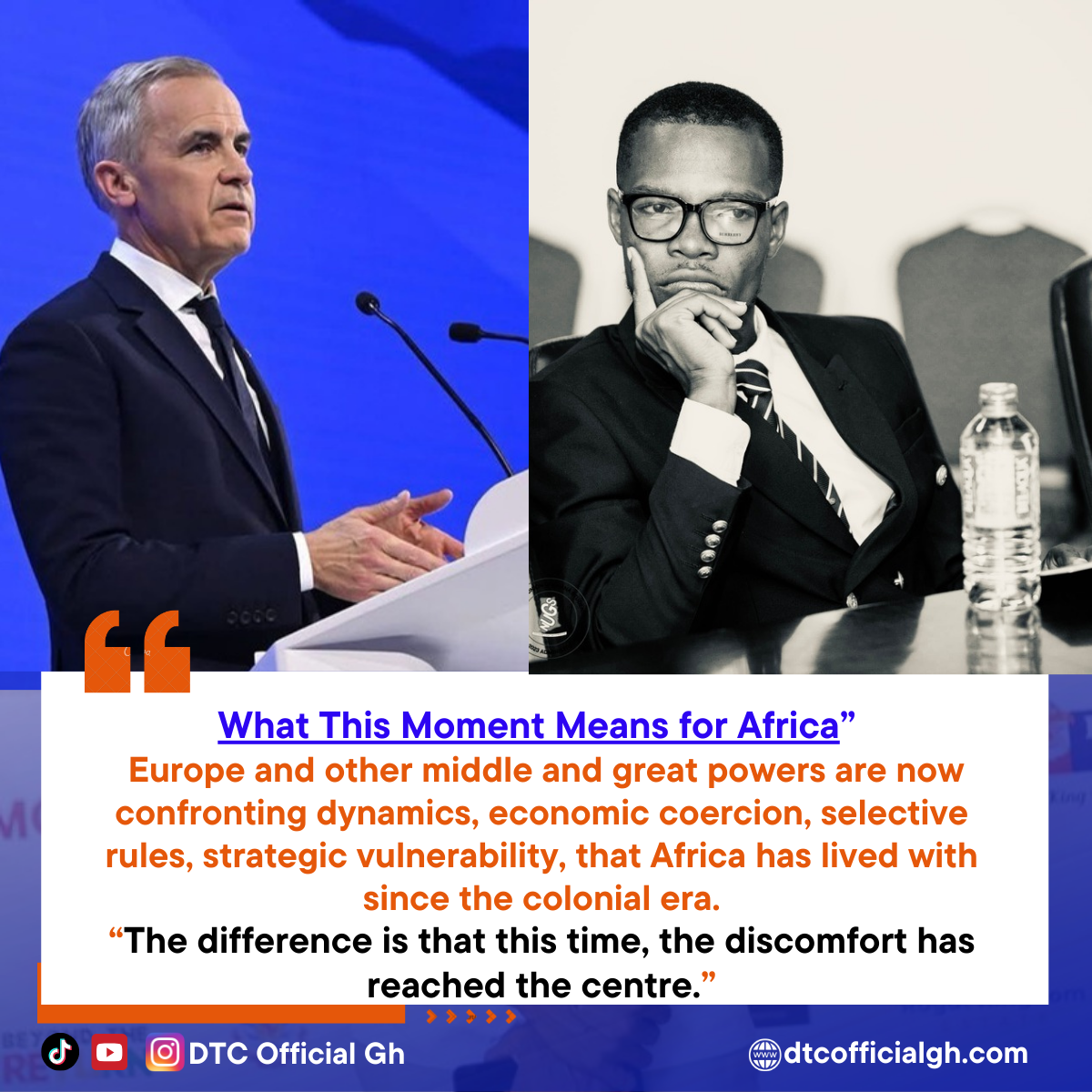
When the centre tastes the medicine of the margins
Mark Carney’s Davos speech matters for Africa not because it introduces a new reality, but because it confirms, publicly and unapologetically, that the world Africa has endured for centuries is now being experienced by those who once designed and benefited from it. When a G7 leader declares that “we are in the midst of a rupture, not a transition,” Africa should hear recognition, not surprise.
Europe and other middle and great powers are now confronting dynamics, economic coercion, selective rules, strategic vulnerability, that Africa has lived with since the colonial era. The difference is that this time, the discomfort has reached the centre.

When the Lie Breaks at the Centre
Carney urges countries to “stop invoking the ‘rules-based international order’ as though it still functions as advertised.” For Africa, this order rarely functioned as advertised in the first place. The continent was integrated into global systems as a source of labour, raw materials, and strategic depth, while rules were enforced unevenly and often suspended when African interests were at stake.
Carney concedes what Africa has long known:
“The strongest would exempt themselves when convenient… and international law applied with varying rigour depending on the identity of the accused or the victim.”
What is new is not the injustice, but the fact that Europe and its peers are now experiencing the same exposure. Economic pressure, weaponized trade, financial leverage, and strategic blackmail, tools once routinely used against weaker regions, are now being felt by those who assumed immunity.
They are speaking up now because they are discovering they were never as safe as they believed. As long as coercion was directed outward, toward Africa, Latin America, or parts of Asia, there was silence. The rules were defended not because they were just, but because they were comfortable.
Africa’s Long Reality
Carney’s admission that “great powers began using economic integration as weapons” lands differently in Africa. For the continent, integration has often meant dependency without protection. Africa exports raw materials, imports finished goods, relies on external currencies, and depends on foreign-controlled financial and logistical systems.
When Carney says,
“You cannot ‘live within the lie’ of mutual benefit through integration when integration becomes the source of your subordination,”
he is describing Africa’s structural position in the global economy, one shaped over centuries, not decades. The shock Europe feels today is Africa’s historical baseline.
Africa Was Strategically Forced to Want It First
Calls for food sovereignty, energy independence, industrialisation, and local value addition were long framed as radical or unrealistic when they came from Africa. Carney now normalises these priorities globally:
“A country that cannot feed itself, fuel itself, or defend itself has few options.”
What Europe and other middle powers are pursuing today as strategic adaptation, Africa sought out of necessity. The difference is that Africa was told these aspirations violated the very rules that others quietly bent or ignored.
For more insights and inspiring stories , kindly follow us on Twitter and WhatsApp for more.
Multipolarity Reveals Old Truths, Not New Ones
Carney notes that as rules erode, countries hedge and diversify. Africa has always diversified, not out of strategy, but survival. The danger now is that multipolarity, if unmanaged, turns Africa once again into a contested space rather than a coordinated actor.
His warning is particularly relevant:
“When we only negotiate bilaterally with a hegemon, we negotiate from weakness… This is not sovereignty. It is the performance of sovereignty while accepting subordination.”
Africa has performed sovereignty for decades under constrained choices. The rupture Carney describes does not automatically liberate Africa; it merely removes the pretence that the constraints were fair.
Living in Truth: Africa’s Moral Advantage
Carney frames the path forward as “living in truth”, naming reality, acting consistently, and building real strength. Africa possesses a moral clarity others are only now acquiring. The continent has never been confused about how power operates; it has simply lacked the collective leverage to change it.
To live in truth for Africa means no longer softening language to protect partnerships that perpetuate dependency, no longer excusing coercion because it comes from a “friendly” direction, and no longer fragmenting its voice in a world that rewards scale.
It also means recognising a hard irony: Europe and others are finding their voice now not because the system has become unjust, but because its injustice has finally reached them.
READ ALSO: Has Democracy Failed Africa? A Candid Conversation with Mrs. Ngonadi
Carney concludes:
“The old order is not coming back. We should not mourn it. Nostalgia is not a strategy.”
For Africa, nostalgia for inclusion in a system that extracted, disciplined, and marginalised it was never a viable strategy. The current rupture is dangerous, but it is also revealing. It exposes a world where power has always mattered more than principle, and where those who once enforced silence are now learning to speak.
Africa’s task in this moment is not to seek validation from a newly awakened centre, but to organise itself with the confidence of those who have always known the truth. In a world where others are just beginning to remove the sign from the window, Africa must ensure it is finally seated at the table, not as a subject of sympathy, but as an author of what comes next.
For more insights and inspiring stories , kindly follow us on Twitter and WhatsApp for more.


